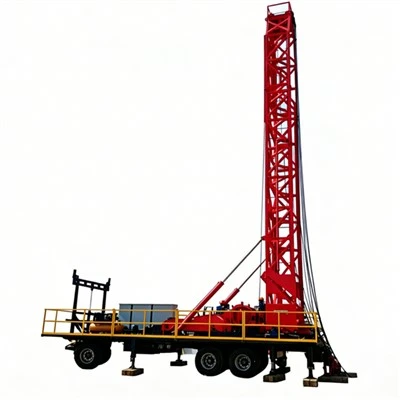
If you’ve ever watched a trailer-mounted drilling rig roll up to a job site—whether it’s for water well drilling, geothermal testing, or small-scale soil sampling—you might’ve thought, “That big drill bit’s obviously the star, right?” Nah, not even close. The thing that keeps that 15,000+ lb rig from careening down a dirt access road, stopping on a steep well pad, or slamming into a loaded pickup at a job site parking lot? The braking system. And no, it’s not just the same brakes on your personal work truck. It’s built specifically for these rigs, and getting it right is non-negotiable for us as a trailer-mounted drilling rig supplier. I’ve seen too many job sites where a cheap, mismatched brake part turned a routine load-in into a disaster, so let’s break this down like I’d explain it to a new field tech who just started with our team. Trailer-mounted Drilling Rig
First off, let’s get one thing straight: trailer-mounted drilling rigs aren’t small toy trailers. Even a compact unit (the kind we ship for residential water well jobs) hits around 7 tons fully loaded with drill pipe, a mud pump, and a small crew’s tools. Bigger industrial rigs? We’re talking 12+ tons when they’re loaded with 30-foot drill stems, a larger mud system, and a water tank for drilling fluid. So their braking system isn’t an afterthought—it’s a purpose-built, multi-part system designed to handle three way bigger loads than a standard 5×8 utility trailer brake. Let’s go through each part, step by step, no jargon that makes your eyes glaze over.
First, the main workhorses: the brake axles. Most of our mid-sized trailer rigs run on two independent brake axles, not one. Here’s why: if you only have one braked axle, that’s half the braking force when you hit a steep gravel road, and your trailer could fishtail—especially when you’re towing at 55 mph down a rural highway. Each of those axles has electric drum brakes, wait, no—wait, for rigs over 10 tons, we step up to hydraulic surge brakes? No, actually, let’s clarify: smaller, more maneuverable rigs (used for residential water wells, like the ones we sell to folks out in Texas or the Midwest) use heavy-duty electric trailer brakes, but our larger industrial drilling rigs (for construction site soil testing or geothermal loop drilling) run on hydraulic surge brakes with a hydraulic assist. Wait, no—actually, surge brakes are better for heavy loads because they activate based on the actual force of the truck slowing down, not a manual electric signal that could glitch if a wire gets damaged on a bumpy road. That’s a key point for us: our rigs are designed for off-road and backroad use, so wire damage is a real possibility. Surge brakes eliminate that risk. Let me get specific: each brake assembly on our standard trailer rigs (the one we most commonly supply) has 12-inch drum brakes, but we offer an upgrade to 14-inch if you’re running a super heavy setup with extra drill pipe. The brake shoes are made of a heat-resistant composite, too—because when you’re stopping 12 tons, those drums get hot, and regular brake shoes glaze over and stop working fast. We learned that lesson early on, when a customer who’d just bought our first 2019 model brought it back because his brakes stopped working after a 20-mile haul up a 6% grade. Switched to the heat-resistant shoes, and haven’t had that complaint since.
Next, the brake controller, but not the basic one you get at AutoZone. For the rigs that use electric brakes, we pair them with a proportional brake controller that’s mounted in the tow vehicle’s cab. A proportional controller doesn’t just send a set amount of power to the trailer brakes— it matches how hard the tow truck’s brakes are being pressed. So if you’re tapping the brakes to slow down on a gravel road, it sends a little power; if you’re slamming on them to avoid a deer darting out, it fires all the brake force on the trailer’s axles. For our surge brake-equipped rigs, we have a hydraulic master cylinder mounted on the trailer’s tongue, not the tow vehicle. That master cylinder connects to a pushrod that sits against the tow vehicle’s frame. When the truck slows down, the trailer pushes forward on the pushrod, which squeezes the master cylinder, and that sends hydraulic fluid to the brake calipers (wait, no—surge brakes for trailers still use drum brakes, right? Yeah, I mixed that up. Surge brakes for heavy trailers use hydraulic pressure to engage drum brakes on the axles. So the master cylinder’s fluid lines go straight to the wheel cylinders on each brake, no external controller needed. That’s why they’re more reliable for heavy loads off-road. I always tell our customers: if you’re towing this rig on a mix of highway and dirt, splurge on the surge brake setup. It’s cheaper in the long run than fixing a trailer that’s crashed because brakes failed.
Then there’s the parking brake. You can’t just leave a 12-ton rig parked on a 10% grade and rely on the service brakes—those would overheat and fail overnight. Our parking brake system is a separate mechanical lever that engages all four brake shoes on the trailer’s axles. It’s not like the tiny emergency brake on your work truck; it’s a heavy-duty steel lever mounted on the trailer’s tongue, connected to a steel cable that runs along the undercarriage, all the way to each brake axle. We recently upgraded that cable to a corrosion-resistant galvanized steel, too—because job sites get dusty, muddy, and sometimes salted in winter if you’re working in northern states. A rusted cable is the last thing you want when you’re trying to park on a steep well pad. I remember one customer in North Dakota who had a cable snap during a January job, and his rig rolled 15 feet into a snowbank. Cost him $2,000 in repairs and a delayed project. That’s why we don’t cut corners on those parts.
Wait, also—what about brake line safety? A lot of people don’t think about this, but when you’re towing a trailer, the brake lines connecting the truck to the trailer (or the lines between the master cylinder and the axle brakes) are at constant risk of getting snagged on rocks, brush, or debris on a job site. For our rigs, we run all brake lines through heavy-duty steel conduits that are bolted to the trailer’s frame, not just hanging loose. And we use flexible braided stainless steel lines at the points where the axle moves up and down over bumps—because regular rubber lines crack after a few years of exposure to sun and dirt. We even include extra lines and a basic repair kit with every rig we ship, just in case a line gets damaged mid-job. That’s the kind of small thing that separates us from other suppliers, right? We don’t just sell the rig and bolt on brakes—we make sure the whole system is built for the actual conditions our customers work in.
Another big one: load-sensing brake adjusters. Most standard trailer brakes have manual adjusters that you have to crank every few months. That’s a pain, especially for rigs that are towed every week. Our trailer rigs have automatic brake adjusters that do the work for you—they adjust the gap between the brake shoes and the drum every time you use the brakes, so the stopping power stays consistent no matter how much wear there is on the shoes. We tested this during our 2022 field trial out in Wyoming, where a customer towed our rig 10,000 miles over rough dirt and highway roads, and never had to adjust the brakes once. That’s a huge win for our customers, who are out drilling wells or testing soil, not spending weekends tinkering with trailer brakes.
Wait, let’s address a common misconception here. A lot of people think: “If my tow truck has heavy-duty brakes, I don’t need heavy-duty trailer brakes.” No. Even the toughest work truck can only apply so much weight to its own brakes. When you have a 12-ton trailer, 60% of the stopping force has to come from the trailer’s brakes, otherwise you’ll cause the tow truck’s brakes to lock up, which leads to jackknifing. That’s a rule we drill into every customer when they order a rig from us. We actually include a towing guide with every unit that specifies the minimum brake requirements for the tow vehicle, too—like, if you have a 8-ton drilling rig, your truck needs at least a 3/4-ton chassis with upgraded brakes to pull it safely. We don’t let customers skip that, because we’ve seen what happens when someone tries to save money with an underpowered truck and mismatched brakes. Last year, a customer in Arizona tried to tow our 10-ton rig with his half-ton pickup, and the trailer’s brakes locked up on a downhill, pushing the truck into a fence. He had to replace both the truck’s front end and the trailer’s brakes. That’s $10k in damage he could’ve avoided if he’d listened to our guide.
Now, let’s talk about maintenance, because even the best brake system doesn’t work if you don’t take care of it. As a supplier, we make sure every rig we ship comes with a printed maintenance schedule for the braking system, but we also have a video tutorial on our website that walks you through the basics. For example, every 50 hours of operation, you should check the brake fluid level (for surge brake models), inspect the conduits for damage, and test the parking brake. Every 100 hours, you should adjust (or check the automatic adjusters) and clean the brake drums of any mud or debris. We also offer a 12-month brake system warranty, which is standard for our rigs, because we stand behind the parts we use.
Wait, is there anything I’m missing? Oh—emergency breakaway brakes. That’s non-negotiable for all trailer brakes, no exceptions. If the trailer somehow comes loose from the tow vehicle (which is rare, but it happens if a hitch pin fails), the breakaway mechanism triggers the trailer’s brakes automatically, so it doesn’t roll away and cause a crash. Our breakaway system has a 10-pound battery mounted in a weatherproof box on the trailer’s tongue, and a lanyard that connects to the tow vehicle. If the lanyard pulls out, the battery sends power to the brake system, engaging all brakes. We test this on every single rig before it leaves our yard. I once watched a tech test the breakaway on a new rig, and the lanyard got stuck on a jack stand—no big deal, he reset it. But a customer of ours in Oklahoma had a hitch pin pop out during a turn, and the breakaway kicked in, stopping the trailer before it rolled into a group of workers at a well site. That’s exactly why we invest in those systems.
Water Well Drilling Rig Look, at the end of the day, the braking system on a trailer-mounted drilling rig isn’t just a set of parts—it’s the safety net that lets our customers do their jobs without worrying about crashing their rigs, delaying projects, or hurting anyone. We don’t cut corners on this because we’ve seen the cost of doing that. Every brake shoe, every line, every adjuster is picked with the rig’s weight, the conditions our customers work in, and their need for reliability. If you’re in the market for a trailer-mounted drilling rig, don’t just ask about the drill head or the mud pump—ask about the braking system. And if you’re looking for a supplier that actually knows this stuff, and builds rigs that are tested for real job sites, hit us up. We’re ready to talk through the details, answer your questions, and make sure you get a rig that’s safe, reliable, and fits your needs.
References
- Trailer Braking Systems: Design, Operation, and Maintenance Manual. North American Trailer Manufacturers Association, 2021.
- Heavy-Duty Trailer Brake Component Testing Report. Journal of Heavy Vehicle Systems, Vol. 28, No. 3, 2022, pp. 217-235.
- Safe Towing Practices for Trailer-Mounted Work Equipment. Occupational Safety and Health Administration (OSHA) Publication 3740-17, 2023.
Hebei Zhongxin Machinery Equipment Co., Ltd.
As one of the most experienced trailer-mounted drilling rig manufacturers in China, we also support customized service. We warmly welcome you to buy high quality trailer-mounted drilling rig for sale here from our factory. If you have any enquiry about pricelist, please feel free to email us.
Address: Wangxizhang Industrial Zone, Zhao County, Shijiazhuang City, Hebei Province, China
E-mail: zxnjbzg@163.com
WebSite: https://www.hbzxdrilling.com/
